
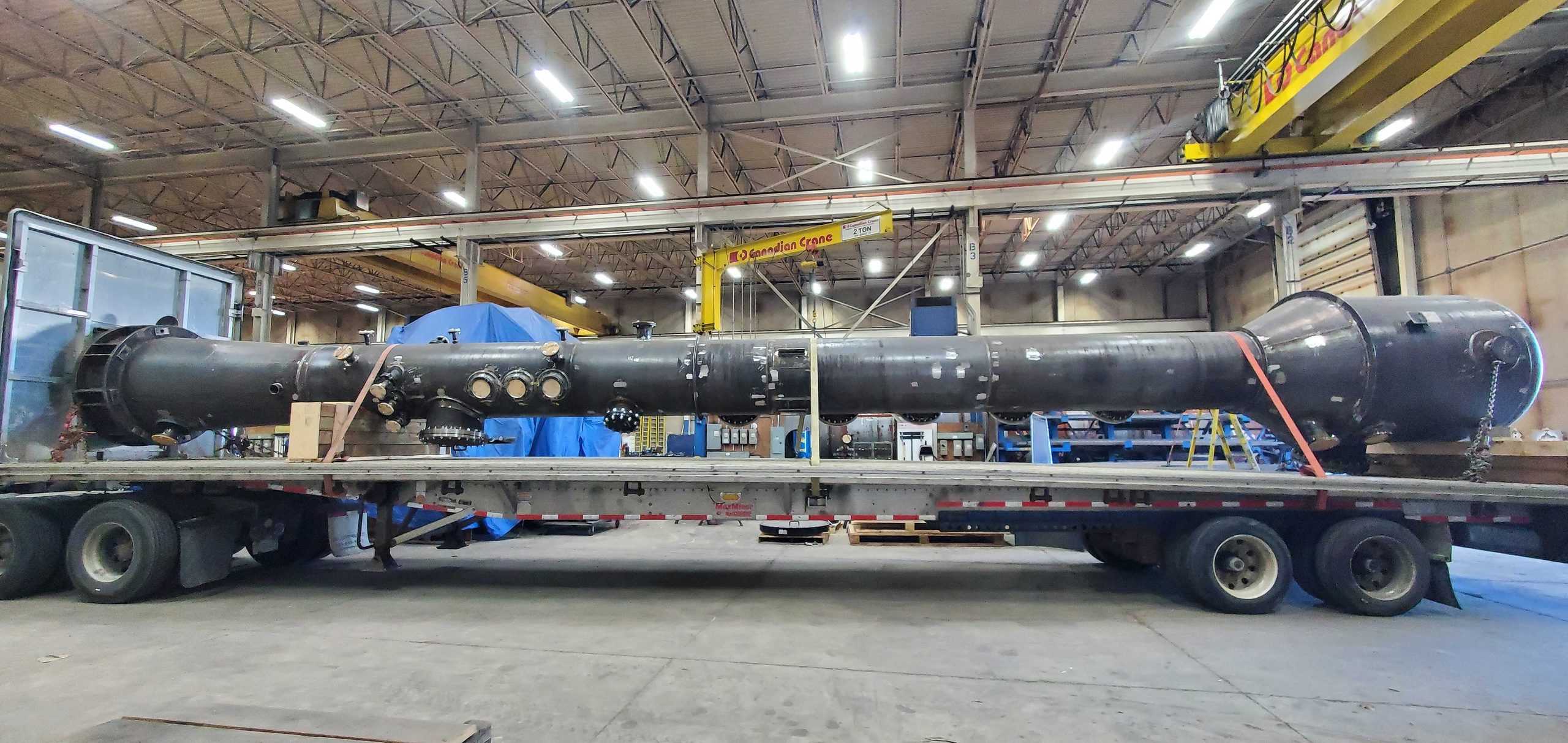
The carbon steel vessel on this flatbed measured 13 m tangent to tangent. That measurement stops where each head starts to curve. Using 13 m for a freight quote would leave out the depth of both ends. The pressure vessel shipping dimensions a carrier needs are the full length, width and height of the package in its shipping position. View the food and beverage vessel project.
What to Measure on the Shipping Drawing
Ask for a side view and an end view in the shipping position. A vessel that stands upright in the plant may travel horizontally on saddles. Show the supports and attachments that will travel with it.
| Measurement | What to include |
| Overall length | Measure end to end, including the heads, projecting end connections, flange covers and any skid overhang. |
| Overall width | Use the outermost point on each side. A manway cover and a side nozzle can both add width, even at different positions along the shell. |
| Package height | Measure from the underside of the lowest shipping support to the highest attached point. Include any skid, saddles or blocking that will travel with the vessel. |
| Shipping weight | Give the weight as shipped, including installed internals and temporary supports. List each separately packed piece with its own weight and dimensions. |
When the Shell Diameter Understates the Width
We fabricated a flare drum with a 15 ft diameter shell. It travelled partially insulated, and its shipping envelope measured about 18 ft wide by 18 ft high. A carrier working from the shell diameter alone would have missed roughly 3 ft of width. See the flare drum project.
Which Attachments Should Travel with the Vessel
A welded side nozzle travels with the shell. A bolt-on platform can sometimes travel separately. If the platform sets the width, ask the fabricator for dimensions with it installed and with it removed. Compare the freight difference with the cost of packing the platform and installing it at the plant.
How Trailer Height Affects an Ontario Shipment
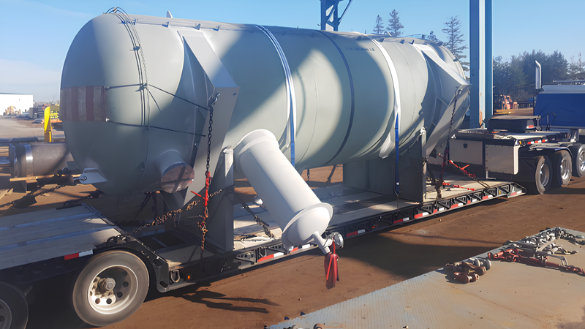
Suppose a vessel measures 3.25 m from the underside of its saddles to the top flange. If the saddles sit directly on a trailer deck that is 0.95 m above the road when loaded, the flange travels at 4.20 m above the road. Any additional blocking under the saddles raises it further.
Ontario’s general limits for a vehicle including its load are 2.60 m wide and 4.15 m high. In this example, just 50 mm puts the load over the general height limit. The carrier can compare trailer options and check route clearances, loaded length, axle weights and permit requirements. Read Ontario’s guide to oversize and overweight loads.
The Last Turn Into the Plant
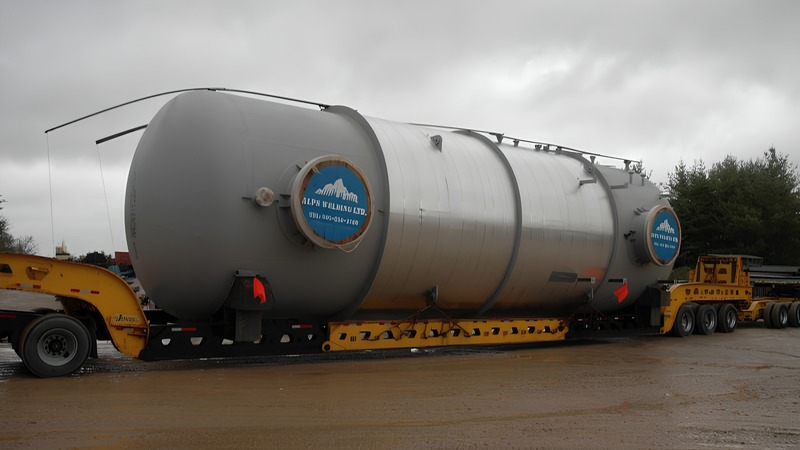
A long vessel can fit between two gateposts and still need more room to turn in from the access road. Give the carrier a site plan showing the approach to the gate, overhead pipe racks and the unloading area. Mark the narrowest opening and the lowest overhead clearance you know.
What to Include in Your Pressure Vessel RFQ
Our Woodbridge, Ontario, facility has an 18 ft × 18 ft shipping envelope and a maximum equipment weight of 150,000 lb. Use these figures for an initial fabrication review. The carrier checks the proposed load against the route to your plant. Explore our fabrication capabilities.
Include the following with your request for quotation (RFQ) so the fabricator and carrier can work from the same assumptions.
- A dimensioned sketch and estimated shipping weight for each piece. Mark preliminary figures clearly.
- A list of items that will ship attached and those the site team will install.
- The delivery address, receiving window and known restrictions on site access.
- Who will book freight, provide shipping supports and arrange unloading.
If your vessel has to fit through a particular gate or beneath a pipe rack, send that clearance with your preliminary drawing.